
GTM Phase 1: Transactionality.
The 3 main KPI's
TTV
.png)

TRACTION


SHOPPER ACCOUNTS
It must all be part of a carefully detailed design and execution
This will make our number projections valid and our bizz model confirmed
.png)
First 60 days.
- Implement LIVE BETA USAGE with Second Set leveraging in relationships and known Merchants
- CONCLUDE detail of GTM Framework & Plan
- Work on and reach deals with Second Set of targeted merchants belonging to Priority Universes 1-2-3
Total Transaction Value
Traction [measurable]
Shopper Accounts
The next 120 days.
ONVO must approach with determination the Selected A's & B's of every selected Space / Subspace / Merchant: Start generating TRACTION.
- Build success case history with "AFFILIATED MERCHANTS" that will lead to a validated model which we can replicate and propagate in our selected Spaces.
- Measure penetration and impact on our selected Spaces with regard to our KPI's Construct Metrics that will feed our Bizz Model Projections.
- Build on our incremental capabilities, our LEARNINGS / FINDINGS to leverage on USE CASES that have gone through our Decision Matrix.
By the end of this period we will be able to better understand WHAT ONVO needs to bring to our Spaces and Merchants: More capable of providing incremental value to our clients.
The 'SHOPPER ACCOUNTS' model must / will be tested and validated.
- Work on and REACH predetermined initial targets for Universes 4 & 5, and prepare the groundwork and capabilities sizing/backlog for Spaces 6-10.
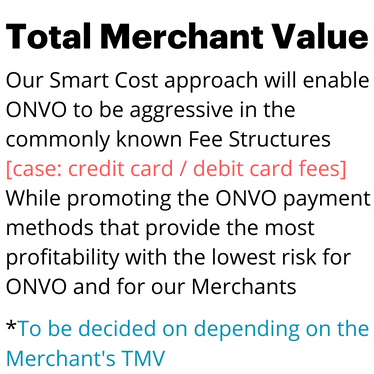
Total Merchant Value / Total SPACE Value
The concept of 'individual transaction P/L' is
secondary in the GTM phase
ONVO's GTM will use a SMART P/L METRIC for
the Merchant as a whole, hence the use of:
Total Merchant Value [TMV]
Through this: ONVO will outperform competitors
that only provide partial sets of products / services /
capabilities with an "old school P/L"
What are the main driving takeaways of Phase-1 GTM analysis?
The GTM tactical guideline is constructed on 5 pillars:
. The Current State of the Product [CSP]
. Total Merchant Value > SMART COST MODEL
. Shopper Accounts
. Initial Adoption Friction
. USP
- CSP
1. The CURRENT STATE OF THE PRODUCT drives the initial rollout (betterments and effort must be sized for phase 2) All comercial efforts in Phase 1 must be congruent and in line with the [CSP]
2. The [CSP] is a moving target in constant evolution that MUST respond to the trajectory and vision the company takes (and not the other way around).
At any given point we will have a [CSP] which must be clear and deeply assimilated by our outreach/commercial teams, as the current state and subsequent upgrades and rollouts will create new states with additional (different) capabilities which will always dictate the capacity and pace for further penetration into our targets. [CSP DELTA] will be a consideration for every new approach beyond Phases 1 & 2
- TMV + SMART COST MODEL
3. In order to successfully penetrate our selected markets, ONVO must focus on TOTAL MERCHANT VALUE [TOTAL SPACE VALUE] and not on individual transactional P/L
This leads ONVO to construct a SMART COST MODEL that must dynamically and swiftly respond to USP approaches required to "WIN" in a selected target. *REVERT TO BINARY DECISION MATRIX & OUTLINE BOARD FOR DETAIL
- SAC's
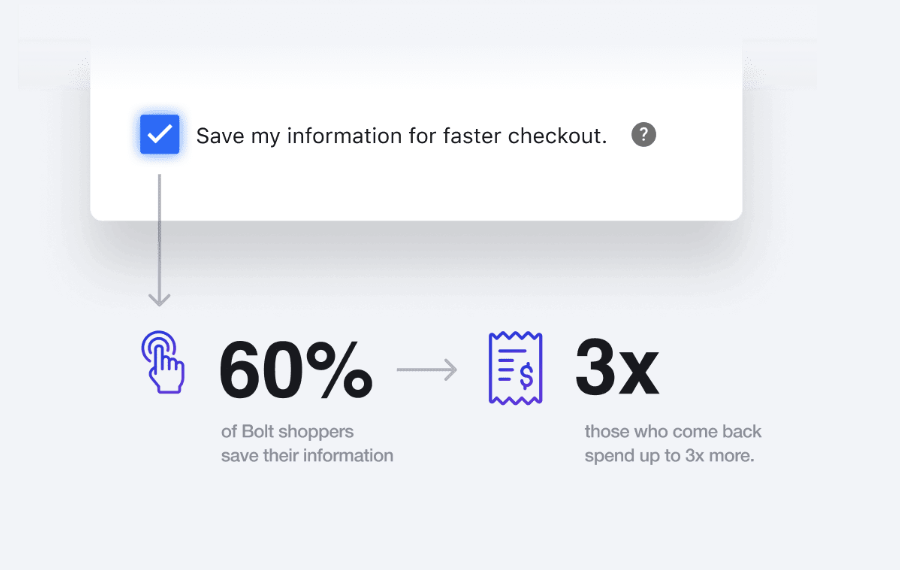
4. SHOPPER ACCOUNTS
ONVO's CHECKOUT process enables Shoppers to save their information (personal and payment methods) for future use 'system wide'
This will organically and inevitable create ONVO SHOPPER ACCOUNTS and accumulate registered users
Even if Phase 1 & 2 do not contemplate a particular set of value KPI's for ONVOs users, they will add to the SHOPPER ECOSYSTEM which becomes a selling point for new merchants as the ONVO-1 click checkout assimilates and grows across our merchant network
ONVO's approach to SHOPPER ACCOUNTS CREATED [organically at checkout] is the alpha stage of the Registered User Value
- INITIAL ADOPTION FRICTION & USP
- INITIAL ADOPTION FRICTION is the level of obstacles and objections that ONVO must overcome to achieve transactional state with a Target. We will focus on the ones that present a combination of HIGH TMV + LOW IAF
- USP : ONVO must craft a USP for every target that responds to our GTM OUTLINE STRATEGY in order to improve success rate and assimilation. We are the newcomers and we have to act accordingly.
"ONVO IS NEW. ONVO IS MORE & ONVO IS BETTER"
PHASE 1 must focus on UNIVERSES > SPACES > SUBSPACES > MERCHANTS that will present the least INITIAL ADOPTION FRICTION
GTM Phases 1 & 2
Will focus on the Spaces with the most potential relative to our [CSP] and [CSP DELTA]
Go